![RAYLASE Logo Email 150 dpi.png]](https://content.raylase.de/hs-fs/hubfs/RAYLASE%20Logo%20Email%20150%20dpi.png?height=40&name=RAYLASE%20Logo%20Email%20150%20dpi.png)
Introduction and fundamentals
When a laser beam of power P_0 strikes a material, some of the power is absorbed
(taken up by the material), some is reflected (backscattered), and the remaining power is transmitted (passed through the material).
It applies:
P_0 = P_abs + P_ref + P_trans
Depending on the material and the properties
of the laser beam, the power components P_abs, P_ref and P_trans vary greatly in their amount. For example, P_trans is close to zero for many metals (e.g. workpieces in laser material processing),so the incoming power is exclusively absorbed and reflected. In contrast, lenses and glasses in laser beam deflection units are typically designed to minimize P_abs and P_ref.
Nevertheless, it is not possible to eliminate these components. Power is reflected at every surface of a lens or protective glass, and power is absorbed within these components.
By using suitable coatings, reflection can be limited, but not completely avoided.
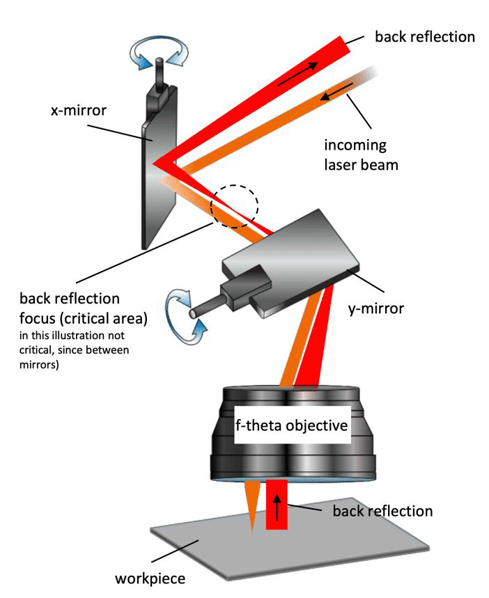
Figure 1:
Illustration of the reflection from the process zone. For better recognizability, the incoming laser beam and the reflection are displayed spatially separated. The focus of the back reflection lies in the illustration between the mirrors and is therefore not critical. Attention: The lenses of the f-theta objective also generate back reflections! These are not shown here.
Relevance to beam deflection units
Depending on the design of the deflection unit, reflections occur at various points in the overall system. Particularly relevant are
■ the surface of the workpiece
■ protective glasses
■ f-Theta-lenses
■ f-lenses (only in pre-focusing units)
■ z-lenses (only in pre-focusing units
It should be noted that back reflections from transmitting components (lenses, protective glasses) occur at both the entrance and exit surfaces. The back reflections become particularly critical if they are focused by a lens on their way through the deflection unit and the focus thus generated is close to another (optical) component.
Strategies to avoid critical back reflections
The following strategies are important to avoid damage caused by back reflections:
■ Use clean optical components! Clean the components that are particularly susceptible to contamination (e.g., protective glasses) thoroughly and professionally!
■ Avoid processes where excessive reflection from the workpiece is to be expected (e.g. "heating" copper with infrared laser radiation, in some cases > 90 % reflection power)!
■ Avoid processing workpieces outside the specified working plane! This strongly influences the beam path back into the deflection unit and means that the focal points of the back reflections may no longer be in the safe areas.
■ Use components designed or tested by RAYLASE! The use of unknown lens rings and lenses can lead directly to damage if they have not been tested with regard to back reflections.
■ Do not use laser powers above the specifications provided by RAYLASE.
■ If you are unsure whether a modification to your machine is critical for back reflections, contact our experts at RAYLASE. We can assist you in the evaluation process.
Example 1:
You are processing a reflective material with a 2-axis deflection unit + f-theta lens (e.g. RAYLASE SS-IV). A certain amount of the power hitting the workpiece is reflected off the workpiece in the direction of the f-theta lens. The returning laser light is focused by the lens into the interior of the deflection unit. If the focus of the back reflection is on a mirror or lens, they can be destroyed. When designing the system, therefore, care must be taken to ensure that the focus point lies in a non-critical area. This is implemented by RAYLASE specialists using lens rings and suitable lenses for your application.
Example 2:
You are working with a prefocusing deflection unit (e.g. AXIALSCAN-50 Digital II) and, over time, contamination occurs on the output protective glass. The contamination significantly increases the amount of power Pref reflected at the protective glass. The reflected laser light is focused by the f-lens inside the scanner, and the focus is near the z-lens. In the clean state, this might not have been a problem because the back-reflected power was very low and thus not critical to the z-lens. The contamination of the protective glass and the resulting increased reflected power can exceed the destruction threshold of the lens at the focus of the back reflection.
Explanations about defects
If a defect has occurred and, for example, a mirror has been damaged by a back reflection: Please contact our service department. We will assist you in narrowing down the cause of the defect. Please note:
■ By examining a damage it is not always possible to deduce its cause. Without detailed knowledge of your system, it is often not possible to say where a reflex could have come from.
■ We are happy to support you in preventing damage in the future. In order to do this effectively, we depend on information about your system or machinery.
We hope to have helped you with these explanations! We would be grateful for any suggestions and feedback you may have at support@raylase.de.